


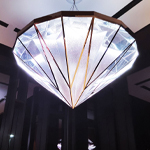

In addition to being a growing, critical market for Ideoli, Toronto is also a city that inspires our creativity! Recently, Ideoli’s Co-Founder and Chief Product Officer, Chris Hartswick, took some time during his business trip in Toronto to visit the Royal Ontario Museum (ROM). This stunning museum houses world-class collections of art, culture and history. With over one million visitors per year, ROM tops the attendance charts among museums in Canada, and it’s also one of the most-visited museums in the world. The museum opened over 100 years ago and has since had several additions, the latest of which is an architecturally stunning design by Daniel Libeskind. The structure resembles large gems or minerals, and it’s unique, beautiful design inspire us to create stunning showcase products of our own. Wherever we go, we’re always on the lookout for inspiring food, architecture or anything else that helps keep us invigorated, and Toronto’s ROM is a great example of one of our inspirations.

Not only is Toronto the largest city in Canada, with a metro area of over 5 million people, but it’s also one of the most beautiful cities in the world, with a vibrant, diverse culture. We may be a little biased, as our CEO and Co-Founder George Stroumboulis was born in Toronto, but we love this city and see great potential to expand Ideoli’s footprint here. As we become more of a global company, Ideoli has been expanding its North American operations from California and New York to now also include Toronto. Having a strong footprint in Toronto helps for a variety of reasons, including giving us more flexibility to manage challenges such as international trade tariffs, as well as access to new talent pools, new partners and a booming construction and real estate market. With the development of new condos and other high rises in Toronto, we see a great opportunity to add our lighting products and other fixtures and furniture to these spaces. Expanding to new markets and supporting our partners growth is what we’re all about! Stay tuned for more updates on our activities in Toronto and throughout Canada

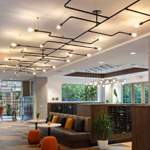
Ideoli’s resident tech expert —our Co-founder and Chief Product Officer Chris Hartswick— is back again to explain how our new Y fixture delivers great functionality and design for our clients. The Y fixture can be used as a standalone light fixture, or multiple units can be combined to create cool designs. “Developing our Y fixture was actually a really fun project, ” says Chris. “Our client is a high-end gym that wanted to develop a unique space where the light fixtures could actually change in coordination with what was going on. So whether it’s yoga, or cycling, or anything, they needed a fixture that could react to what they were doing. ” In addition to being highly configurable in shape, the Y fixture also has the flexibility to help clients create the vibe they’re looking for based on when and where the lights are used. “The second aspect of the Y fixture that makes it so exciting is it’s color-changing ability. Whether it’s installed as an individual unit or installed as a grouping, the beauty is it all gets wired together and they react at the same time,” says Chris. Stay tuned for more updates from Chris on how our world-class technology helps clients invigorate their spaces!

Being an entrepreneur can be incredibly fun and rewarding, but it’s important to recognize the downsides in order to find the right balance in life and find a sustainable way to move forward. As our CEO and Co-Founder George Stroumboulis notes, frequently traveling for work can be exciting, but it’s also a grind and takes away from family time. On a recent international trip, he traveled 15 hours for just four hours of meetings. And even though he was only away for a short time, having his four-year-old daughter cry when seeing him leave and asking him not to go on the trip was heartbreaking. However, George is committed to finding a good balance and tries to incorporate his family in his work, such as by bringing his daughters to his office and even jobsites when possible, rather than only being around on the weekends. George comes from an entrepreneurial family, so he knows that starting and running a business can be a mixed bag, and it’s important to be honest about the pros and cons so as not to burnout. By sharing this story, we hope we can help other entrepreneurs struggling with the downsides of this lifestyle. Speaking honestly about these challenges can encourage the entrepreneur community to come up with better ways to counteract the negatives of this role.

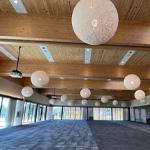
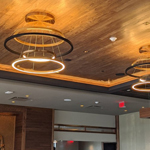
In addition to growing our products in markets across the world, there are also so many great opportunities to grow right here within our home market, the US. That means that we’re often taking trips all over this huge country to meet with clients and partners, and we wanted to document some of the progress we’ve made by taking a whirlwind, five-day trip to visit 10 cities in the US where our products are installed, covering nearly 10,000 miles. To do so, we sent our uber-talented Production guru, Kosta, across the country with a camera and coffee in hand. He started in the East Coast in New York and made his way to Baltimore, Orlando and Atlanta to film our LED lighting products, custom decorative light fixtures and quality furnishings. Then he headed west to Denver, Salt Lake City and Las Vegas, to capture our custom end-to-end chandelier and LED lighting fixtures. From there, he made his way to what turned out to be a not-so-sunny Los Angeles and San Diego to check in our round glass LED fixtures, custom furnishings and LED backlit mirrors. Lastly, he headed back east to Stamford, Connecticut, to capture our dome-shaped lighting pendants. Being as focused as we are on global expansion, it was great to also take some time to review what we are doing right here in our backyard!

As we build out our international footprint, we want to make sure we’re also making a positive impact on the local communities where we operate. “Invigorate Your Community” is an initiative we started to help deliver this positive impact and influence on those around us. We gain a lot from the communities we serve, so we think it’s important to give back and invigorate those communities too. An example of how we do this is by volunteering for causes we care about. Recently, the Ideoli team volunteered at Encore Community Services in the Times Square area of New York City, where we served over 200 hot lunches and packed 1,200 meals for seniors. Encore Community Services provides seniors with a range of caring and quality services to help them live independent and dignified lives. We look forward to invigorating more communities around the world by giving back with our time, money and other resources. Stay tuned for more updates on how we’re making a positive impact on the communities where we operate!

Around the world in 80 days? Try less than four. In about 90 hours, Ideoli literally traversed around the world on business trips to meet with clients and suppliers, covering the 25,000-mile circumference of the globe. We started this trip in Los Angeles, flying from LAX to Singapore on a 17-hour flight, one of the longest one-way trips in the world. From Singapore, we made the relatively short trip of about a two-hour flight to Bangkok, Thailand. Next, we stayed in South Asia with another quick flight to India, followed by a 10-hour flight all the way to Germany. Finally, we completed our trip around the world on an approximately 11-hour flight home to Los Angeles. While this trip was intense, it was worth it to meet new clients, expand into new markets and further build our global business. Our ambition and passion for what we do drive us at Ideoli, even when it means taking red eye flights around the world.

As frequent world travelers meeting with clients and partners in a variety of different markets, we’ve made it part of our ethos to soak up the local culture wherever we go. Recently, that meant skipping a private car service to go to a meeting while in India. Instead, our CEO and Co-Founder, George Stroumboulis, decided to hop in a tuk-tuk to get to the meeting. If you haven’t been in a tuk-tuk before, think of it as a motorized rickshaw with no shocks, no air conditioning, and no seat belts. You just sit back and…don’t relax! It’s quite the harrowing adventure, but it’s also exhilarating. Not only was the trip exciting, but it only cost around $2 to get to the meeting and back, which is a deal that’s hard to beat. Stay invigorated while traveling but stay safe too! Tuk-tuks probably won’t become our go-to mode of transportation anytime soon, but it was a great experience.

Buenos Aires is a beautiful city in Argentina that has so much to see and do, and it’s also a great place for business! Ideoli recently established a team in the area and started working with local clients, so we brushed up on our history and want to share a few interesting facts we found: 1. The city has influences from many countries:From its indigenous roots, to the colonial era in the 16th Century starting with Spain, to large influxes of European immigrants during the 18th and 19th centuries, Buenos Aires has a multicultural background that is apparent in its current culture, such as with varied architecture that looks like what you might find in places like Madrid or Paris. 2. It’s a book lover’s paradise:By some measures, such as that of the World Cities Culture Forum, Buenos Aires has the most bookstores per capita among the world’s largest cities. One of the most famous is El Ateneo Grand Splendid, which National Geographic says is the most beautiful bookstore in the world. 3. The subway system is one of the world’s oldest:The city’s subway system started in 1913, making it the first in Latin America and older than Madrid’s network. Today, the city’s system known as Subte has 87 stations, and there’s so much beautiful, varied artwork that you can see across the network. 4. The nickname for Buenos Aires residents is porteños:In Spanish, this name simply means someone who comes from or lives in a port city, and though it’s used elsewhere, it’s particularly stuck as a nickname for the people of Buenos Aires. 5. The food is incredible: The city’s multi-cultural background is evident in its food, such as with Italian influences leading to great pasta and pizza. There are also so many great Argentinian staples you can try in Buenos Aires, ranging from empanadas to delicious steak. Buenos Aires is an amazing city, and we look forward to spending more time there as we grow our business!

There are three main metrics when it comes to measuring light output -Lumens, Candelas and Lux (Metric). Lumens: Sheer volume (amount of light that is radiated) Candelas: Intensity or strength (Narrow or Spread out). Narrower, higher candela. Lux: the illumination intensity of an area; customers usually care about this a lot. How the light hits whatever you’re shining it at. Lighting designers/architects ask for IES files because they want to figure out how the light is going to be delivered to the space Lumens: Benefits of LEDs is that you can integrate it into the fixture There can be 850 Lumens on a spec sheet but that’s not what can be coming out of a fixture. That is the lumens from the source. Ex: Incandescent Light bulb has 850 Lumens from the source but only delivers 450 Lumens because it lacks efficiency LED delivers 750 Lumens in this example because it’s more efficient LED Chip mounts to reflector, which focuses light into a lens, and the lens goes into a diffusor which softens it; makes beam angle wider but it is for the aesthetics of the beam Lumens that we put on our spec sheet are delivered lumens Every time you have light go through something else/different medium;you lose some of that light Beam Angle: Where you hit 50% of your maximum intensity; all based on your candelas If you have 1000 lumens focused, and maximum intensity is 2000 candelas, your angle is where you hit 50% of that intensity on either side (1000 candelas) Field Angles is based of 10% on either side Cutoff: Where there is no light Types of Beam Angles: Narrow Medium Wide Beam> Extra Wide Beam How do you change the angle? -Optic (Lens, reflector, etc.) will help focus lights in different ways, dependent on the Optic OpticFC/Lux: The farther you go;the less light hits the space. For example: 50 foot candles arewhat you want on an office desk. How do they measure all this? They take a giant sphere (integrating sphere) and put the light source in the middle. They close it and it gets measured, and that’s where you get the report. Integrating sphere also measures all your color and lumensoIt traps everything in the middle, nothing escapes, so you get a pure reading. In order to get a beam angle, you have a humongous system with mirrors called a goniophotometer and they measure the beam angle. These systems costa lot of money, which is why companies generally use labs to figure these things out, which is why labs are always backlogged and will take time to come back with results. LM79 is an official report that comes from a third party government approved safety lab. Therefore, even if we had this equipment, unless the government came and certified/inspected us, we wouldn’t be able to produce our own LM79. Wow, that’s a lot of information about lighting. Now you can go tell all your friends about it, let ’em know Ideoli taught you!

From our production runs in manufacturing facilities around the world to our global travels via a variety of transportation modes, we take safety very seriously in all forms. Not only is it the right thing to do to protect ourselves and those we work with,it also helps us meet our commitments to clients, as injuries and other safety incidents can cause serious delays. Fortunately, many individuals and businesses like us are participating in National Safety Month, which takes place in June and focuses on reducing the top causes of injuries and death at work, on the road and in homes and communities. This year, notes the National Safety Council, the focus is on: 1. Hazard Recognition2. Slips, Trips and Falls3. Fatigue and Impairment We recommend thinking about how these risks take shape in your own workplace or other environments, and see if there are ways you can take preventative action. Meanwhile, we’ll be sure to do even more to educate our employees and partners on hazards at our manufacturing facilities and project sites; usingthe right equipment and awareness to reduce slips, trips and falls; and recognizing the signs and dangers of fatigue and impairment and then stopping work as needed. Everyone can get involved in reducing the risk of injuries. Stay safe!

Choosing the right lighting can be a difficult endeavor, as you not only have to consider energy usage and style but also how the color of the light source will illuminate your space. However, lighting color is not absolute but rather based on a complicated set of factors such as how much energy the bulb emits, which affects what color you ultimately perceive. Still, one way to benchmark lighting color is to use the color rendering index (CRI), which quantifies the ability of a light to reveal colors accurately in comparison to an ideal light source. CRI involves a scale from 0 to 100 percent, with 100 being the same as daylight. Thus, you often want to find a light source with a CRI of 90 or higher, which is considered excellent and will reflect the objects in your space close to how they would appear in natural light. While in certain instances you may not want natural light, it’s often beneficial to keep colors as relatively true as possible. For example, a grocery store might think it’s a good idea to use an LED light source that has a lower CRI but which spikes the amount of red emitted so that their meat look better than it actually does. However, once the customer gets home and looks at the meat under their own light source, the meat may not look as good and they may think it’s starting to spoil or something else is off with the quality of the product. That’s why we often recommend aiming for a high CRI, barring special circumstances. By understanding CRI, you can find lighting that better illuminates the colors in your space, which can ultimately help you please clients.